
During our stay at Sunriver, we had two fun day trips--the first to the High Desert Museum and the second to the Lava River Cave--both a short distance from the resort.

Oddly enough, we chose to go to the High Desert Museum on a rainy day. The weather forecasters on the news were so elated about the rain, we couldn't possibly complain. (As explained previously, we visited Oregon in July when wildfires seemed to be raging all around us.)
The "High Desert," which encompasses most of Central Oregon, is so named because it has an elevation that averages from 4,000 feet to 6,000 feet above sea level. (This explains our rather surprising journey to Sunriver when the acres of pine forests suddenly turned into high rock ledges covered in juniper and sagebrush.)
Another fun fact is that the "high desert" formed up to 30 million years ago from lava flows, which means it is covered in volcanic rock. The area receives little rainfall because the Cascade Mountain Range prevents precipitation from reaching it; therefore, places like Bend, Oregon receive less than 12 inches of rain annually. Nonetheless, the Oregon High Desert still receives too much rainfall to be classified as an actual desert. While there is the occasional hedgehog cactus (which grows no more than a foot tall), most of the terrain (particularly around Sunriver) seemed more like sandy grassland mixed with some dry trees and forest. During the spring, the area boasts colorful wildflowers.


The two main rivers in Central Oregon are the Crooked River and Deschutes River, which meet to form Lake Billy Chinook (a popular destination for boaters). During our Sunriver Resort Float Trip, we had a chance to see the Deschutes River up close and personal, which again, gave the illusion that we were floating more through a fertile river valley teeming with wildlife rather than a sandy desert.

The Animals
I write about our first experiences of Central Oregon because the High Desert Museum boasted a collection of animals much larger than just snakes, turtles, and reptiles--animals of the High Desert include frogs, salamanders, and amphibians; mule deer, elk, coyotes, cougars, bobcats, gray foxes, and red foxes; and badgers, skunks, jackrabbits, porcupines, otters, and beavers (to name a few). Inside, we had a chance to view their Desertarium, which included animals like snakes, lizards, turtles, tortoises, frogs, fish, and owls. Here were some of my favorites:


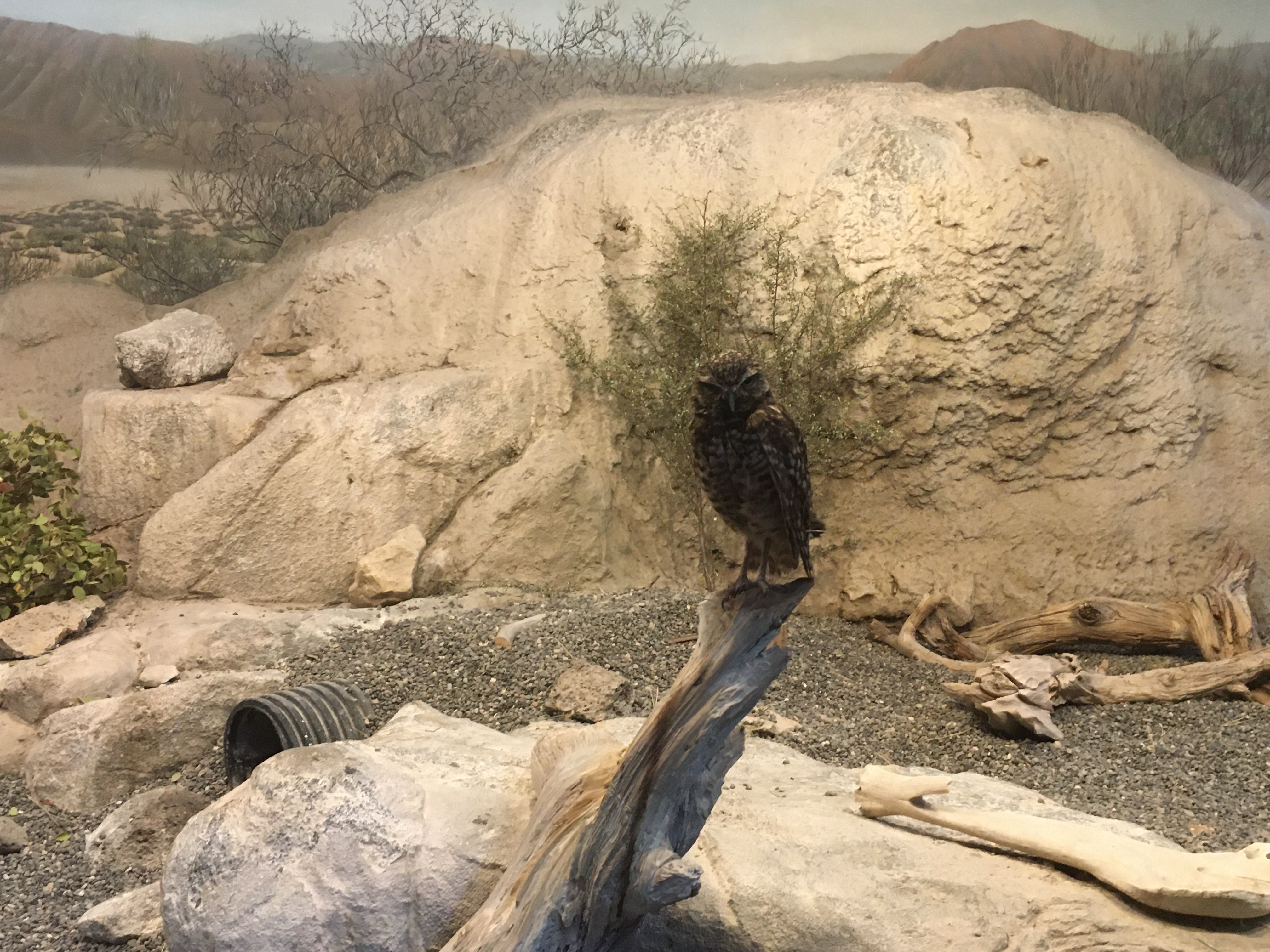

Outside, in another building, there was the Donald M. Kerr Birds of Prey Center, which includes such predators as owls, hawks, eagles, falcons, and vultures, and then our favorite exhibit of all--the Autzen Otter Exhibit!! Can you tell where we spent the most time?


Many of the animals at the museum were taken in because they were injured and needed to be nursed back to health. Others are living at the museum permanently because they never learned how to fend for themselves in the wild and are too dependent on humans.
After visiting the animal exhibits, we made it right on time for one of their beloved shows where they introduced us to three animals of the High Desert--a skunk, a badger, and a porcupine. The employees would walk around the small theater with each animal, so we could see them up close, and then bring them to a central platform where we could all watch each animal's behavior and antics while they spoke about them.

Our favorite by far was the porcupine. We learned that porcupines, part of the rodent family, are nocturnal and like to feast on trees (bark, leaves, acorns, beechnuts, twigs, and pine needles); as a result, they can usually be found up in the trees, but predators, of course, have to stay away from their quills. The average North American porcupine has about 30,000 quills that are like tiny needles with sharp tips and up to 800 barbs on the sides. While they can't actually shoot or throw their quills, porcupines are protected because the slightest touch can lodge dozens of quills in a predator's body with the barbs making them difficult to remove.


Did you know that baby porcupines are born with quills? The quills are soft, warm, and flexible when they are first born, but within hours, they are hard, so ironically, predators are not the only ones that have to be careful around babies. Mom and Dad Porcupine have to protect themselves, too. Porcupines (since they don't have tails) can lose their balance in trees, meaning they can fall and prick themselves, too. Luckily, the quills have an antibiotic coating, so while the quills make life uncomfortable for predators, the quills won't actually cause an infection. (This is probably because the animal that is most commonly pricked by quills is itself.)
The final part of the show that we LOVED was when the zoologist demonstrated how porcupines climb trees and come down. Our porcupine friend climbed the tree branch head first, but when it was time for him to come down, he backed down very slowly. (They don't have good eyesight, and as mentioned before, they don't have a tail for balance.)
Native Americans and Early Pioneers
In addition to the animal exhibits, the museum also teaches about human history through various displays: By Hand Through Memory, Spirit of the West, and the High River Ranch and Sawmill. There is evidence that Native Americans lived in the region as early as 14,000 years ago. Today, there are seven Native American reservations in Oregon--a result of the Westward expansion of European settlers. The museum showcases the lives, experiences, traditions, handwork (i.e., crafts), and innovations of various tribes, including the Nez Perce, Umatilla, Warm Springs, Yakama, Spokane, and Colville people.


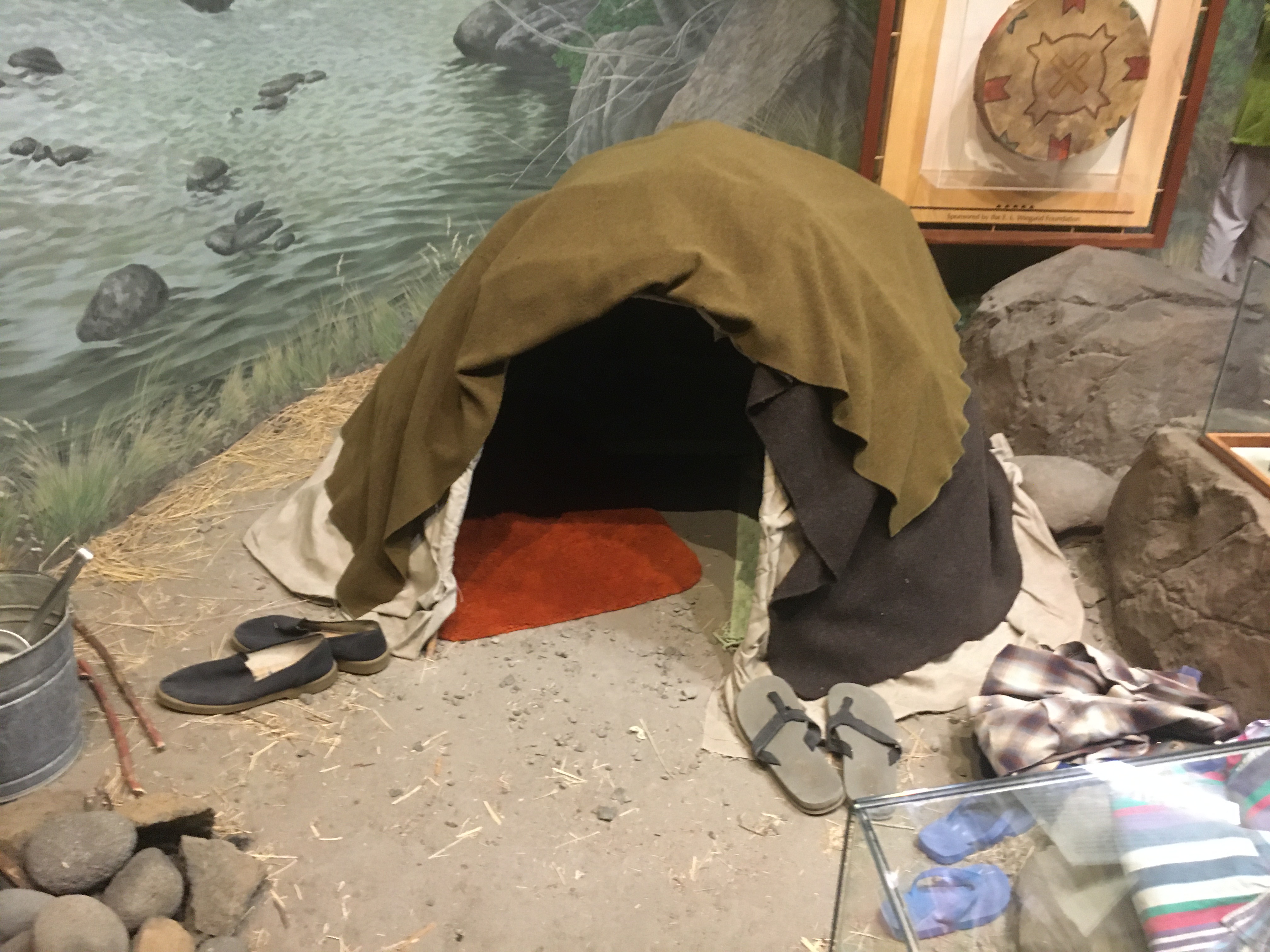

Fur trappers and traders from the 1820s were the first white settlers to enter the High Desert region of Oregon. By 1855, Native Americans were assigned to reservations by a series of treaties with the U.S. government that required them to give up their land and traditions. Further settlements abounded, especially during the discovery of gold to the north in the 1860s and the completion of the transcontinental railroad in 1869 (with further railroad developments through 1884).
In one part of the museum, we get to see a Conestoga Wagon that was used on the Oregon Trail. Since I LOVE history, I was interested in learning more. According to The National Historic Oregon Trail Interpretive Center, "The Oregon Trail was a wagon road stretching 2170 miles from Missouri to Oregon's Willamette Valley. It was not a road in any modern sense, only parallel ruts leading across endless prairie, sagebrush desert, and mountains. From the 1840s through the 1880s, thousands trekked westward, carrying only a few belongings and supplies for the journey, and settling on the western frontier, forever changing the American West."


The Interpretative Center explains the reasons settlers made the journey: "Throughout the 1840s, politicians in the east advocated for settlement in the west, negotiated treaties solidifying claims, and established land grants for settlers. In July 1843, the Provisional Government of Oregon, made up of mostly American settlers, provided a means to claim up to 640 acres, a full square mile. Oregon became a US territory in 1848."
However, the trek was hard and doesn't sound much different from the types of conditions today's immigrants endure: "In addition to the plodding pace and agonizing labor of traveling 2200 miles a step at a time, the trip could kill. In summer, water sources dried up, oxen perished and families endured thirst. Others experienced starvation when they brought insufficient food supplies and found it impossible to live off the land. The route of the Oregon Trail was littered with cast-off belongings as families struggled to lighten the load and save the health of their draft animals."
In conclusion, the Interpretative Center notes, "Each part of the journey had its challenges, but always the need to keep moving and complete the journey before supplies were exhausted, poor health killed, or winter weather closed mountain passages. Between 1841 and 1884, when a network of railroads connected the east coast to the Pacific Northwest, an estimated 300,000 to 500,000 people traveled overland. Some were born along the way, some were buried. Some settled permanently, and some traveled back east. Certainly no one who made the 4–6 month journey was ever the same. For many, it was the most incredible and defining event of their lives. Their legacy of courage and determination is a legendary part of the American experience."
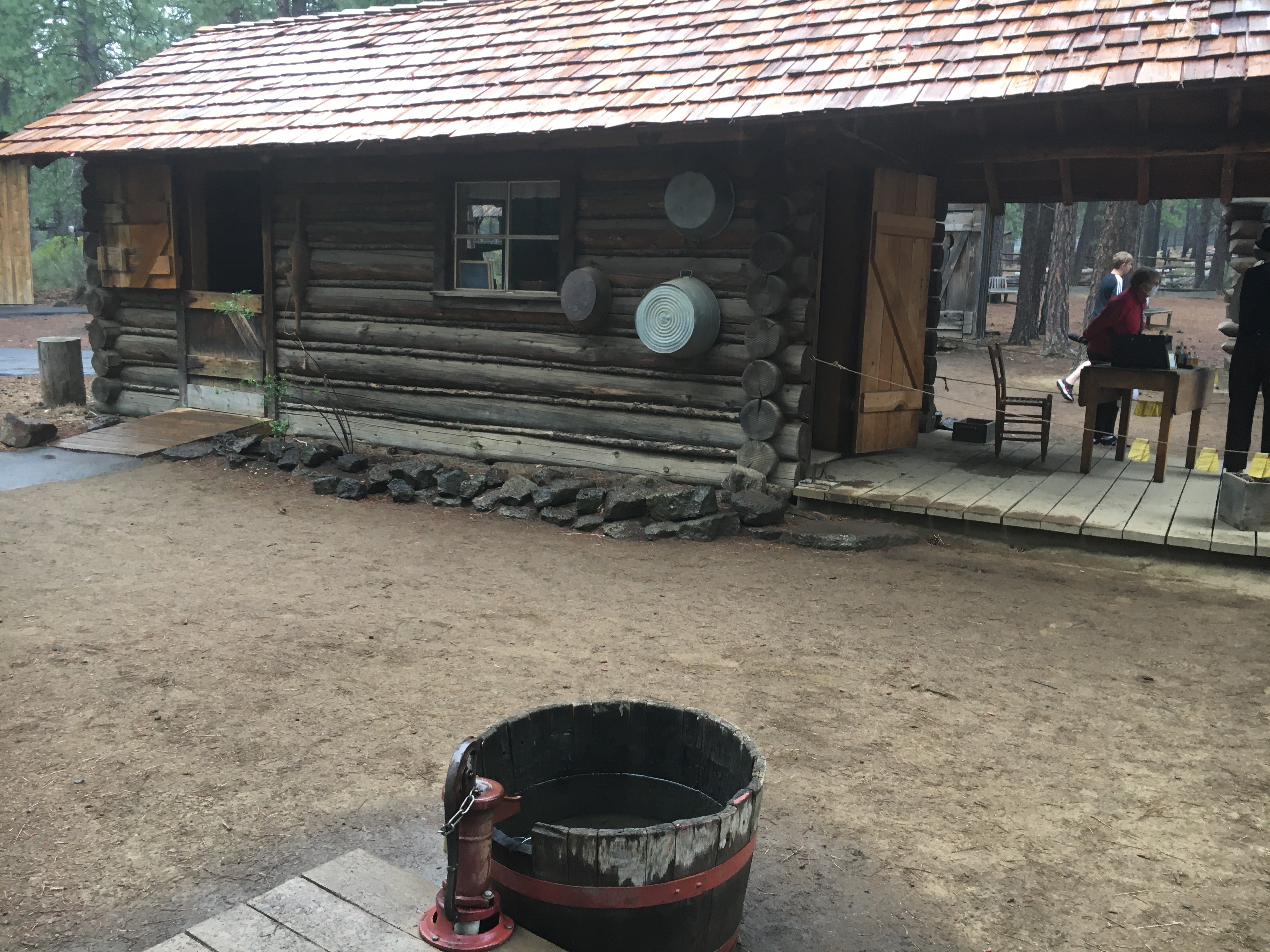
The last, but certainly not the least, part of the High Desert Museum was the Miller Ranch and Sawmill, which showcases the life of a typical frontier family (white homesteaders) who claimed a piece of Central Oregon. It's explained, "Ranch families, like the Millers, worked hard maintaining a cabin, barn, corral, bunkhouse, root cellar and sawmill; caring for the animals; and tending cattle on the open range."
The Museum further details, "When the Millers arrived in 1882, what would become the town of Bend, Oregon was little more than a few families residing along the Deschutes River...Many families moved into the West in the mid-1800s with the encouragement and support of the United States government as a means of bolstering the nation's territorial claim."
At this point during our visit, it was pouring, so while the two boys went back to the car, I slogged straight ahead to see the ranch. The history buff and Laura Ingles Wilder fan in me wanted to see it, and it did remind me quite a bit of Little House on the Prarie (with the exception that the home was surrounded by the High Desert's dry forest).


 |
| I had a chance to meet with the doctor who only comes around every few months. |

 |
| The family outhouse. |


 Posts
Posts


